
In June 2024, I was on vacation in Edinburgh, casually trying to take photos, when I heard a soft voice behind me ask, “Can we click each other?”
I smiled.
Indians tend to use the word, “Click,” instead of “Snap.” Just like they say “stitch” where I would say “sew.” Small language differences that quietly hint at entire worlds shaped differently from your own.
We took photos of each other.
And then we talked.
For four hours while hopping on and off the bus.
We spoke about life, marriage, expectations versus reality, and how I was married with five children and still deeply enjoying travel. Somewhere in that long conversation, I did something bold: I convinced her to invite me to her wedding whenever that day came.
That moment shaped a decision I didn’t yet fully understand.
I would not visit India until her wedding.
And when I did, I would finally see the Taj Mahal, a lifelong dream.
India had always been my childhood country crush, sealed into my imagination by Sunita and Vikram in Yeh Vaada Raha. Regardless of news cycles or social media narratives, that version of India lived quietly but firmly in my heart.
Arrival: Cold Nights, Warm Hearts
I arrived in Mumbai, lingered in the airport for hours, then caught a flight to Prayagraj. From there, my friend picked me up and we drove several hours to Pratapgarh.
The family was large, close-knit, and incredibly welcoming. That first night, we sat by a fire, the December cold surprised me, while wedding preparations quietly unfolded around us. Women gathered in groups, singing, dancing, laughing, celebrating.
It felt intimate.
It felt communal.
It felt ancient.
Rituals, Turmeric & Joy
The following day was rich with tradition.
Women in the family performed pre-wedding rituals using rice, wheat, and lentils, symbols of abundance and blessing. Then came the mehendi ceremony: intricate henna designs, music in the air, and endless dancing.
In the evening, we dressed in yellow for the haldi ceremony, where turmeric paste was lovingly applied to bless the bride. The dancing was joyful, the laughter contagious, and the food unforgettable.
Earlier in the day, something unexpected happened, my feet were painted pink!
I was told I was an auspicious guest, a woman believed to bring good omens to the bride.
I felt deeply honoured.
What stayed with me most was the tenderness, how appreciated I was for making the journey, for staying in the family home, for showing up fully. This was hospitality beyond politeness. This was belonging.
A Wedding That Lasted Until Dawn
On the wedding day, I attended a pre-wedding pooja. The bride’s parents invoked Lord Ganesh to bless the union, while a priest performed sacred rites and distributed blessed food to everyone present.
That evening, I arrived at the wedding venue hungry because I knew the menu and excited for the experience.
I ate my way through street food stalls, buffet dishes, and desserts. I watched the groom’s family arrive with fireworks, loud music, and joyful fanfare. Ritual followed ritual before the couple finally met on stage and exchanged garlands.
A Hindu wedding is layered, symbolic, and profoundly communal.
The most sacred moment was the couple walking around the fire seven times, the saat phere, sealing their vows, followed by the groom applying kumkum to the bride.
The ceremony lasted until daybreak.
It was spiritual.
It was beautiful.
It was unhurried.
There were no kisses.
Just quiet smiles, steady eye contact, and presence.
And honestly, that was everything.
If all I had done in India was attend this wedding, it would have been enough. An experience of a lifetime. Stories to treasure. Memories without expiration.
Faith Encounters: Jainism, Buddhism & Hinduism Lived Daily
In Delhi, I stepped into a world completely new to me, a Jain temple.
Here, I learned about Jainism, a faith rooted in radical non-violence (ahimsa). Jains are strictly vegetarian and also avoid root vegetables such as onions, garlic, potatoes, and carrots. The reasoning is deeply philosophical: uprooting a plant destroys the entire organism and disturbs countless microorganisms in the soil.
Non-violence, in Jainism, extends beyond humans, it includes the unseen.
The stillness, simplicity, and restraint challenged my understanding of devotion. This was faith expressed through discipline rather than display.
From Varanasi, I visited Sarnath, one of the most sacred sites in Buddhism. It is here that Gautama Buddha delivered his first sermon.
After the intensity of Varanasi, Sarnath felt like an exhale, quiet, grounded, contemplative.
Varanasi itself became a teacher.
Walking the ghats daily, observing temples, rituals, prayers, cremations, and pilgrimages, I learned more about Hinduism than any book could teach. Life and death coexist openly here. Nothing is hidden. Nothing is rushed.
Varanasi didn’t ask me to understand everything.
It asked me to witness.
And that was enough.
Beyond the Wedding: Cities, Craft & Chaos
India continued to unfold.
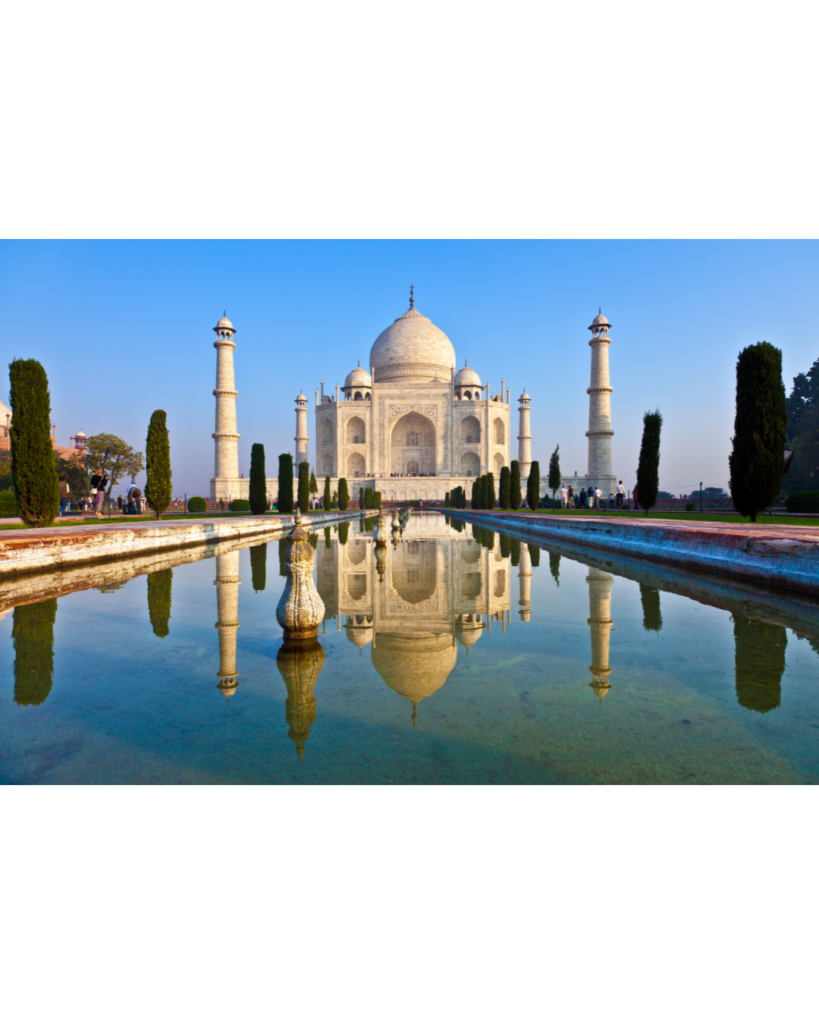
I explored Lodhi Gardens, stood at India Gate, navigated the intensity of Chandni Chowk, and found stillness at the Lotus Temple. I road-tripped to Agra to see the Taj Mahal, the Baby Taj (Itimad-ud-Daulah), and Agra Fort.
I visited workshops for marble inlay art, zardozi embroidery, and gemstone craftsmanship, skills that demand patience, mastery, and reverence.
I also joined a food-tasting tour in Old Delhi, sampling regional dishes that told stories of migration, climate, faith, and history.
Somewhere along the way, I went viral, me in a sari, eating pani puri, with a reel approaching 8 million views.
The Taj Mahal: Love, Skill & Timelessness in Marble
Standing before the Taj Mahal, I fully understood why it is considered a wonder of the world.
Yes, it is a white marble marvel.
Yes, it is visually breathtaking.
But beyond the architecture and the photographs lies something deeper.
The Taj Mahal is a love story carved in stone, built with a level of craftsmanship that feels almost impossible for its time. Semi-precious gemstones delicately inlaid into marble, each piece placed by hand, each detail intentional. The symmetry, the balance, the precision, all speak of devotion, patience, and extraordinary skill.
What struck me most was its timelessness.
Centuries later, the Taj Mahal still stands with quiet dignity, reminding us that beauty created with intention endures. It doesn’t rush you. It doesn’t shout. It simply is, awe-inspiring, serene, and deeply humbling.
The Taj Mahal took my breath away.
It is absolutely, unquestionably worth visiting.
A Note on Indian Food (Its Own Love Letter)
Indian food deserves its own blog post.
Because how can food taste this good, remain so traditional, be so deeply nourishing, and still feel largely untouched by modern shortcuts?
Spices are functional.
Meals are intentional.
Food supports digestion, balance, and wellbeing.
Indian cuisine is philosophy on a plate.
And it deserves space to be honoured properly.
That story is coming.
India Has My Heart
India has my heart, in every single way that matters.
Food.
History.
Culture.
Hospitality.
Spirituality.
My spirit felt at peace, as though I had lived here before, as though no harm could befall me.
Of course, no place is perfect. The traffic was overwhelming, and the constant honking unsettled me. And India is vast, I’ve barely scratched the surface. Each region holds a different rhythm, a different story.
Which is exactly why I’ll be back.
And yes, I went alone.
Visit India.
You may remember something your soul already knows.