
I was planning a trip to the former French Indochina: Laos, Cambodia, and Vietnam. The region between India and China that was deeply influenced by both civilizations and later colonized by the French. Yet, though Thailand and Myanmar occupy the same crossroads of geography and culture, their colonial histories diverged: Thailand remained proudly independent, while Myanmar came under British rule. That difference still shapes how each nation expresses its identity today. I’d already been to Thailand, but Myanmar sat helplessly on the shelf, staring at me. As a good person 😅 (and as someone on a quest to visit every country in the world 🌍), I decided to include it.
Myanmar, once called Burma, is a Buddhist-majority nation lying between India, China, Thailand, Laos, and Bangladesh. Before this trip, I truthfully didn’t know much about it. The country rarely makes global headlines for the right reasons: the Rohingya genocide, Aung San Suu Kyi’s house arrest, military rule, and ongoing civil unrest have all shaped its recent image.
But I went anyway. A dear friend of mine lives in Yangon with her family, and I’d read about the most beautiful pagoda in the world, the thousands of ancient temples in Bagan, and a cuisine influenced by Thailand, India, and China.
Planning the Trip
Planning a trip to Myanmar in recent years hasn’t been straightforward. With tourism numbers drastically reduced due to political instability, most travel information online is outdated.
ChatGPT (bless its helpful heart 😂) told me I could fly directly from neighboring countries, but in reality, most connections to Myanmar now go through Bangkok.
I got a SIM card easily at Yangon Airport, but make sure you download a VPN before arrival. The VPN app Jump Jump was recommended by my tour guide. The exchange rate hovered around 4,000 Myanmar Kyats to 1 USD.
I booked my Yangon city sightseeing tour on Viator, and my hotel was perfectly located, right in front of Bogyoke Aung San Market, central and convenient.
My day began with a swim in the infinity pool overlooking St. Mary’s Cathedral, followed by a delicious buffet breakfast. The local noodle soup was my instant favorite. 🍜
My friend gifted me a traditional Burmese outfit, which I wore proudly and the compliments poured in! Everyone loved my height, colour, and braids. I felt radiant.
Discovering Yangon
Yangon’s charm lies in its contradictions, colonial and modern, chaotic yet deeply spiritual. My tour took me through bustling local markets, including the banana and coconut market, and into the fascinating world of betel quid, locally called kun-ya.
The Betel Quid Ritual
Also known as paan in South Asia, betel quid is a small, hand-rolled parcel made of:
- Betel leaf – peppery and glossy, looks similar to Nigeria’s uziza leaf and the leaf of black pepper.
- Areca nut – the seed that produces the famous red tint when chewed. I know it is also chewed in Papua New Guinea and a few other regions.
- Slaked lime (calcium hydroxide) – helps release the active compounds.
- Optional additions: tobacco, cloves, cardamom, coconut, or sweet syrups.
It’s believed to aid digestion and refresh the mouth. But watching so many people chew and spit red juice all over : drivers, cyclists, even shopkeepers, was… a lot!
It reminded me of when many in Eastern Nigeria used to snuff tobacco, stained noses, dirty fingers, and all. I’m all for preserving culture, but some habits are better evolved out of, especially when science links them to kidney stones and cancer.
Thanaka: Myanmar’s Beauty Secret
One of the most striking sights in Yangon was Thanaka: a yellowish natural paste worn on the face by women and sometimes men. Made from ground bark, it acts as sunscreen, skincare, and cosmetic all in one.
It’s such a beautiful, uniquely Burmese tradition, a touch of culture literally worn with pride.
Everyday Myanmar on the Circular Train
One of my favourite experiences was the Yangon Circular Train, a slow three-hour loop around the city and its outskirts. It’s the best way to see ordinary life, vendors hopping on and off, farmers returning home, schoolchildren giggling, and buffalo grazing near rice fields.
I had lunch afterward, Shan noodles, a dish from one of Myanmar’s major ethnic groups. Then came a surprise: Lahpet Thoke, a tea leaf salad made from fermented leaves washed like Nigerians wash bitter leaf for soup.
Now I’m convinced, a bitter leaf salad would bang! 😄
Temples, Parks, and Golden Sunsets
The Chauk Htat Gyi Reclining Buddha was one of the most impressive I’ve ever seen, serene, colossal, and beautifully detailed. Unlike in Sri Lanka, temple rules in Myanmar were less strict; selfies were fine as long as you were respectful.
Later, I relaxed at Kandawgyi Park, a peaceful green escape around the lake, and strolled through Maha Bandula Park, framed by colonial architecture and the Independence Monument.
And then came the highlight of any visit to Yangon, the Shwedagon Pagoda.
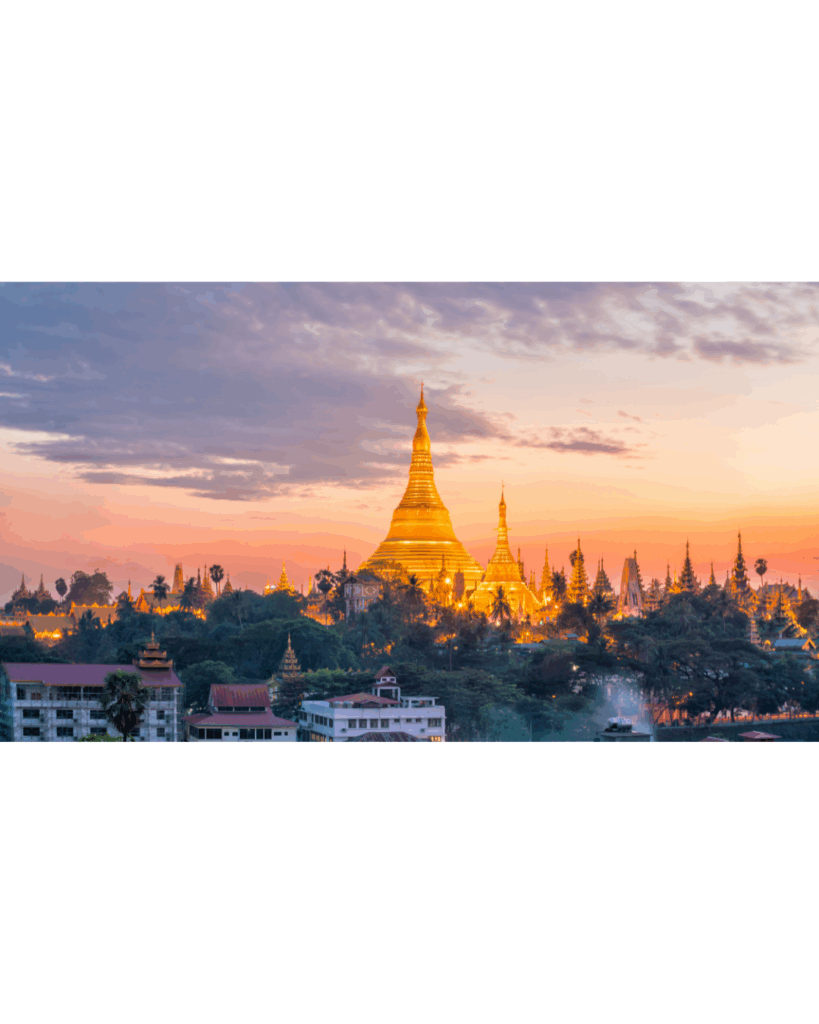
At Shwedagon Pagoda, the most sacred Buddhist site in Myanmar, I was completely awed. The golden stupa glistened under the sunlight, surrounded by worshippers deep in prayer and quiet reflection. There was an unspoken peace in the air, the kind that humbles you and draws you into stillness. The entire complex felt alive with devotion, history, and grace.
I learnt that people here pray at stupas dedicated to the day of the week they were born, each with its own animal symbol and guardian deity. I watched as men and women gently poured water over the small Buddha statues and idols representing their birth days, whispering quiet prayers for blessings and good fortune. I even learnt how to ring the temple bell, a gesture symbolizing the completion of a good deed and an invitation for others to rejoice with you. The soft chime that echoed through the golden courtyard felt like a prayer itself, light, pure, and full of intention.
No words truly do it justice. Draped in gold and legend, glowing against the pink sky at sunset, it’s easily one of the most breathtaking spiritual monuments I’ve ever seen.
🌙 Yangon by Night
After my city tour, I returned to my hotel for a quick shower, then headed out for a street food tour.
We sampled everything from spicy noodles to crispy fritters, washed down with local beer. The night before, I’d had dinner at a Japanese restaurant with my friend and her family. On my last evening, we lounged on the couch watching Odogwu and Achalugo on YouTube, because you can’t take the Nigerian out of us!
💭 Reflections
My visit to Myanmar was short but meaningful. Despite its challenges, I found kind, gentle, and resilient people, eager to share their culture and stories.
I left with prayers for peace, stability, and prosperity for this beautiful nation.
Would I recommend Yangon today?
To experienced, culturally aware travelers, absolutely yes!
To others, maybe wait small!
And I want to visit again……..
✈️ Travel Notes
- Visa: E-visa available online for most nationalities.
- Currency: 1 USD ≈ 4,000 MMK.
- VPN: Essential. Download Jump Jump or ProtonVPN.
- Dress modestly at temples.
- Carry small notes for markets and taxis.
- Best time to visit: November to February (cool and dry).