
I wanted to do something big for my 40th birthday. Something unforgettable.
Naturally, I decided that trekking to Everest Base Camp over two weeks sounded like a perfectly reasonable idea.
The plan was simple: fly to Nepal, hike to Everest Base Camp, come home feeling accomplished and slightly superior to everyone who had spent their birthday quietly eating cake.
There was just one problem.
I couldn’t recruit anybody to join me in March.
At the time, I was disappointed. Looking back, it was a blessing in disguise.
On 28 February, conflict in the region escalated and the airspace over Qatar closed. Imagine if I had convinced friends to pay for flights and a trek costing around $1,800, only for me not to make it. Some disappointments are actually protection.
With Everest off the table, I decided there had to be more to Nepal than simply ticking off a mountain.
As it turns out, there is.
In fact, I might be one of the few people who visited Nepal without properly seeing Everest. Not from lack of trying, mind you. I visited in May, when warmer weather often brings cloud cover. I hiked for mountain views in Nagarkot. The clouds said no. I went to Pokhara and hiked up to Sarangkot hoping to see the Annapurna Range. The clouds said no again.
The Himalayas and I were clearly playing a game of hide-and-seek.
Ironically, not seeing the mountains turned out to be one of the best things that happened during the trip because it forced me to pay attention to everything else.
And Nepal has a lot else.
A Last-Minute Detour to Pokhara
My original itinerary only included Kathmandu.
Then, during my birthday dinner in Doha, my husband and I got chatting with a waitress who happened to be Nepalese. The moment she heard I was travelling to Nepal, she had one piece of advice:
“You have to visit Pokhara.”
At that point my flights were already booked and I was trying very hard not to lose any more money after some cancelled travel plans earlier in the year. Extending the trip wasn’t an option.
Fortunately, I discovered that Pokhara was only a 25-minute flight from Kathmandu.
Suddenly, an overnight trip became possible.
That decision turned out to be one of the highlights of my visit.
Pokhara is beautiful. Nestled around Phewa Lake and surrounded by mountains, it feels calmer and more relaxed than Kathmandu. There are caves, waterfalls, glacier-fed rivers, temples, museums and enough outdoor activities to keep adventure lovers busy for weeks.
You can paraglide, kayak, sail, hike, cycle, enjoy live music, eat fantastic food, or simply sit by the lake and watch the world go by.
I even managed to squeeze in a yoga session before hiking up to Sarangkot for a sunrise view of the Annapurna Range.
The clouds, however, remained committed to the joke.
My first proper glimpse of the Himalayas finally came from a boat on Phewa Lake at sunset.
I accepted the victory.
The Gurkhas and a History I Never Knew
One of the biggest surprises of my trip was learning about the Gurkhas.
While in Pokhara, I visited the Gurkha Museum and discovered a part of Nepalese history I knew almost nothing about. The Gurkhas are Nepalese soldiers renowned throughout the world for their bravery and military skill. For over two centuries, Gurkhas have served in the British Army and fought in conflicts across Europe, Asia and beyond.
What fascinated me most was the contradiction.
Nepal was never formally colonized, yet Nepalese soldiers fought alongside the British in numerous wars. The relationship began after the Anglo-Nepalese War of 1814–1816, when the British were so impressed by the fighting ability of Nepalese soldiers that they began recruiting them into their own ranks.
The museum tells stories of extraordinary courage, sacrifice and loyalty, while also exploring the social and economic impact military service had on Nepalese families and communities.
As someone who enjoys understanding the history behind the places I visit, this was one of the most interesting museums of the entire trip and gave me a much deeper appreciation of Nepal’s unique place in world history.
Kathmandu: Where History Lives
Most visitors stay in Thamel, and so did I.
Thamel is busy, energetic and packed with restaurants, rooftop lounges, souvenir shops, karaoke bars and massage centres. It is touristy, but in a good way. It is also a great base for exploring Kathmandu Valley.
Before visiting Nepal, I knew very little about its history.
I certainly didn’t know that modern Nepal emerged from three ancient kingdoms: Kathmandu (Kantipur), Patan (Lalitpur) and Bhaktapur (Bhadgaon). These rival kingdoms were eventually unified by King Prithvi Narayan Shah in 1768–1769 to form modern Nepal.
Today, their historic centres remain some of the most impressive cultural sites in South Asia.
I visited all seven UNESCO World Heritage monument zones in Kathmandu Valley in a single day.
This was a terrible decision.
A rewarding decision.
Not so terrible if you are physically fit and are there in the cooler seasons.
Between Kathmandu traffic, long staircases, hills and the May heat, I earned every single UNESCO site.
The three Durbar Squares of Kathmandu, Patan and Bhaktapur showcase the incredible craftsmanship of the Newar people through temples, courtyards, palaces, carvings and public squares that have survived for centuries.
Bhaktapur felt like stepping into a living museum.
Patan felt elegant and artistic.
Kathmandu felt alive and chaotic.
Monkeys, Monasteries and Mortality
Swayambhunath, also known as the Monkey Temple, sits high above the city.
The climb is serious.
The monkeys are serious. Loads of monkeys.
I find Buddhist monkeys calmer and friendlier than Hindu monkeys.
The views are worth it.
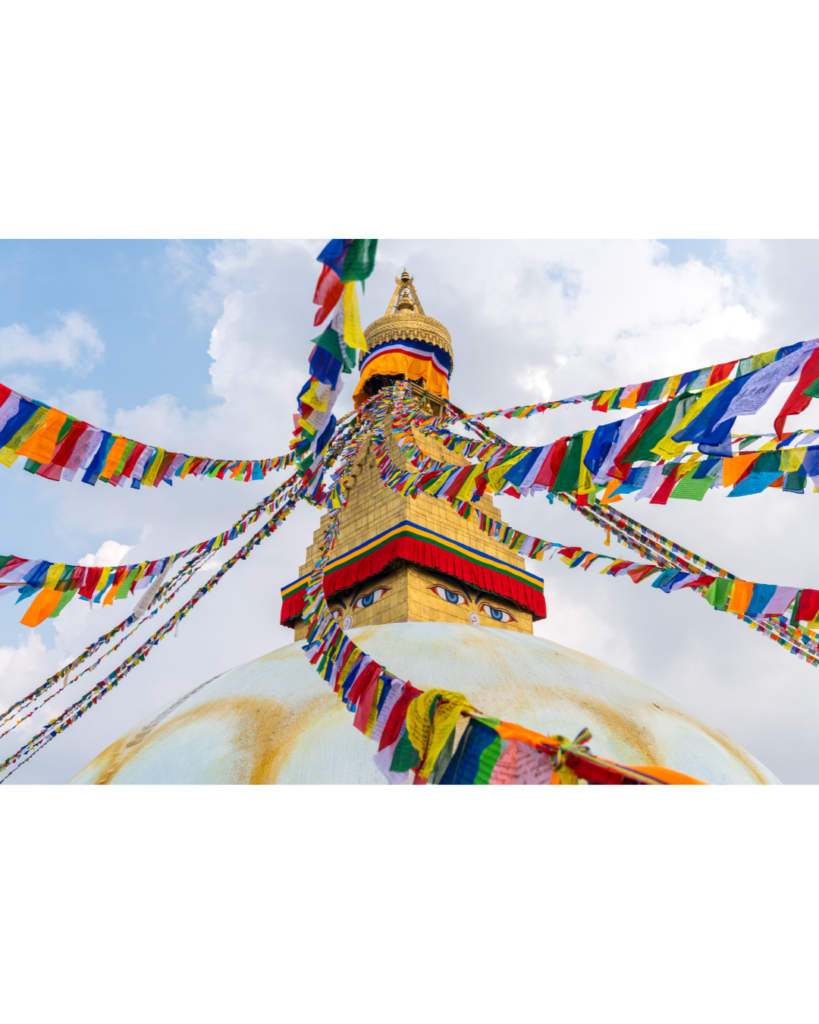
The giant white stupa, colourful prayer flags and sweeping views over Kathmandu make it one of the most memorable places in the city.
While there, I also discovered Nepal’s traditional Thangka paintings. These intricate works of art often feature Buddhist deities, mandalas and scenes from the life of Buddha. Many use gold detailing and require immense skill and patience to produce. They were stunning.
Unfortunately, so were the prices.
Boudhanath was completely different.
One of the largest stupas in the world, it is the spiritual heart of Tibetan Buddhism in Nepal. Pilgrims circle the stupa while spinning prayer wheels, monks move quietly through nearby monasteries, and rooftop cafes offer incredible views over the entire complex.
It was peaceful, reflective and beautiful.
Changu Narayan surprised me as well. Perched on a ridge overlooking the valley, it is the oldest continuously operating temple in Nepal, with inscriptions dating back to the fourth century.
Then there was Pashupatinath.
No photograph can prepare you for it.
Located on the banks of the Bagmati River, it is Nepal’s most important Hindu temple and home to open-air cremation ghats.
I had previously witnessed cremations along the Ganges in Varanasi from the safety of a boat. This was different.
This felt close.
I watched mourners grieving openly. At one point a woman had to be physically supported as she cried and shook while accompanying a loved one to cremation.
The smell lingered in my hair long after I left.
In fact, I washed my braids immediately after returning to my hotel.
It was uncomfortable, emotional and deeply human.
Travel is not always about beautiful views. Sometimes it is about confronting realities that remind us how similar we all are.
Food Worth Travelling For
Nepal surprised me with its food.
The cuisine was so good that I ended up taking a cooking class in Kathmandu because I wanted to understand it better.
If you are new to Nepalese food, my recommendation is the same as it is for India: order a thali.
A Nepalese thali is one of the best introductions to the cuisine because it allows you to sample several dishes at once. A typical thali includes lentil curry (dal), rice, vegetables, potatoes, pickles, curd and often a meat option as well. It is balanced, filling and gives you a wonderful overview of Nepalese flavours.
You must also eat momos while in Nepal.
Momos are Nepalese dumplings and one of the country’s most beloved foods. They can be steamed, fried or served in spicy sauces and come with a variety of fillings. They are affordable, delicious and available almost everywhere.
I also discovered chiura, or beaten rice, which quickly became one of my favourite local foods. It can be eaten straight from the pack, mixed with curd or served alongside spicy meat dishes. It reminded me of the versatility of garri back home.
The Nepalese kitchen can be spicy, so believe people when they tell you something is spicy. Do not ask for extra pepper.
Unless you are Yoruba.
In that case, proceed as your ancestors intended.
And then there was masala cola.
Yes, somebody looked at cola and decided it needed spices.
Naturally, I had to try it for the culture.
Once was enough.
Healing Bowls and Other Discoveries
Another thing Nepal introduced me to was singing bowls.
I had seen them in souvenir shops around the world but never paid much attention. In Kathmandu, however, they were impossible to ignore.
Traditionally, the bowls were said to be made from seven metals corresponding to the seven classical planets and are used for meditation, prayer, mindfulness and relaxation.
We visited a specialty store where the bowls were demonstrated and visitors could test different qualities and tones.
I even had a session myself.
I can confirm that it was incredibly relaxing.
The good bowls were well outside my budget and, if I am being honest, I would rather have someone else performing the therapy. Left to myself, I would probably end up beating the bowl over my own head and achieving the opposite of enlightenment.
Would I Return?
Absolutely.
Five nights in Nepal were enough to convince me that I had only scratched the surface.
I still want to visit Lumbini, the birthplace of Buddha.
I still want another chance to see Everest.
I still want to spend more time in the mountains and explore the villages that have made Nepal famous among hikers.
I would happily return with my children as well. While Kathmandu’s history fascinated me, I think they would especially love Pokhara with its lake, outdoor activities and easy access to nature.
What surprised me most about Nepal was how much it offers.
History lovers will find ancient kingdoms.
Food lovers will find incredible cuisine.
Adventure seekers will find mountains.
Spiritual travellers will find temples and monasteries.
Families will find nature and outdoor activities.
And if you are lucky, unlike me, you might even see Everest.
I arrived in Nepal hoping to discover a mountain.
Instead, I discovered a country.