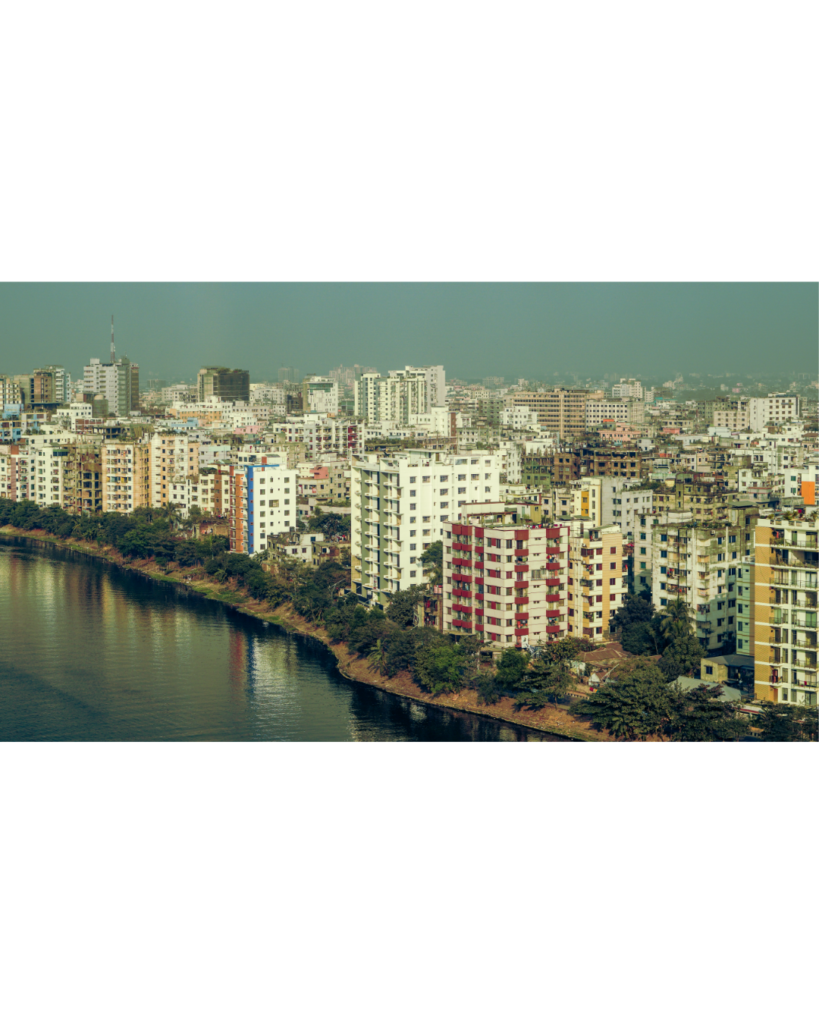

I remember exactly the first time I heard of a country called Bangladesh. It was in 2001 during my boarding school holidays on Bonny Island, Nigeria. I was chatting with an Indian friend when one of his colleagues, a chef, called Imad, joined us. Naturally, I asked where he was from. He replied, “Bangladesh.”
Of course, I had questions. Where was Bangladesh?
He looked helplessly at his Indian friend, who simply said, “Somewhere behind India… not worth knowing.” Imad nodded in agreement.
At the time, India itself had a poor image in much of the international news I consumed. The stories I heard were mostly about poverty, forced marriages and abuse. I couldn’t imagine what could possibly be “worse” than that portrayal.
For years, Bangladesh remained a place I never thought about visiting.
So why did I go?
As many of you know, I absolutely fell in love with India.
During my travels through Kolkata in West Bengal, I learnt that modern Bangladesh was once East Bengal. I became fascinated by the history of the prosperous Bengal Sultanate, the Mughal Empire, and the shared cultural heritage that stretches across today’s India and Bangladesh.
Add to that my mission to visit every country in the world, and Bangladesh suddenly made perfect sense. Since I was already visiting Nepal and Bhutan, I decided to include Bangladesh in the itinerary.
I had originally planned to visit in March, but the regional conflict around Qatar and the temporary airspace closures delayed my trip until May.
If you are planning a visit, I would strongly recommend going during the cooler months. May was incredibly hot and humid, making sightseeing much more exhausting than it needed to be.
Getting the visa
As a Dutch citizen, I discovered I was eligible for a visa on arrival, I wanted to verify that the policy was still in place following recent political changes.
So I visited the Bangladeshi Embassy in Doha.
The gentleman at the gate looked surprised and said,
“Sister, this is the Embassy of Bangladesh.”
He genuinely thought I had come to the wrong place.
I was warmly welcomed. After reviewing my Dutch passport, the staff confirmed that I could simply obtain my visa on arrival by presenting proof of accommodation, an onward flight ticket and paying the US$50 visa fee.
The arrival process in Dhaka was smooth and straightforward.
I did learn that Nigerians travelling on Nigerian passports often face greater scrutiny because of concerns about organised crime and human trafficking involving a small number of individuals. Personally, however, whenever I mentioned that I was Nigerian, I experienced kindness and curiosity rather than hostility.
First impressions
Bangladesh challenged many of my assumptions.
The people were warm, welcoming and incredibly hospitable.
At the same time, parts of Dhaka struggled with waste management, air pollution and traffic congestion. These were simply my observations from a very short three-day stay and shouldn’t be taken as representative of the entire country.
One thing that immediately stood out was just how densely populated Bangladesh is. With around 175 million people living in approximately 148,460 square kilometres, it is one of the most densely populated countries in the world. You feel this everywhere, from the packed streets to the endless streams of auto-rickshaws weaving through traffic.
Traffic in Dhaka can be legendary. Distances that look short on the map often take well over an hour.
A history richer than I imagined
The more I explored, the more I realised how little I knew.
Bangladesh was once home to one of South Asia’s richest regions. Medieval Bengal was famous for its trade, textiles and scholarship.
I visited Sonargaon, one of the ancient capitals of Bengal, and wandered through Panam City, a beautifully preserved merchant town that tells the story of Bengal’s prosperity.
The country is dotted with magnificent Mughal architecture, forts and mosques. Some buildings almost look like miniature versions of the Taj Mahal.
One of my favourite visits was the beautifully preserved Armenian Church in Old Dhaka. I loved learning how Armenian merchants settled here centuries ago, built a thriving community and left behind a remarkable heritage that Bangladesh continues to preserve today.
Bangladesh’s history also explains one of the world’s most important international observances.
After the partition of British India in 1947, Bangladesh became East Pakistan. Although both East and West Pakistan were majority Muslim, language became a major point of conflict. When attempts were made to impose Urdu as the national language, Bengalis fought to preserve their own language and identity.
The Bengali Language Movement eventually inspired International Mother Language Day, now celebrated every year on 21 February around the world.
Bangladesh finally gained independence after the brutal Liberation War of 1971.
My itinerary
Old Dhaka City Tour
This was an unforgettable introduction to the city.
Highlights included:
- National Parliament Building
- Curzon Hall
- Dhaka University
- Dhakeshwari National Temple
- Lalbagh Fort
- Shakhari Bazaar
- Armenian Church
- Star Mosque
- Ahsan Manzil (Pink Palace)
- Boat ride on the Buriganga River
- Ship-breaking area
- Local markets
- Railway market
Sonargaon & Panam City
A perfect day trip from Dhaka.
We visited:
- A traditional Jamdani weaving workshop
- Goaldi Mosque
- Boro Sardar Bari
- Folk Art and Craft Museum
- Panam City
- River cruise
- Rural villages and traditional homes
Although Sonargaon is only about 34 kilometres from Dhaka, the journey took around 90 minutes because of traffic.
The food
I absolutely loved the Kacchi Biryani. It was easily one of my favourite meals of the trip.
I also wanted to try the Bangladeshi version of pani puri, but my guide refused to let me. He was convinced it would upset my stomach. My stomach is usually quite adventurous, but he was so insistent that I eventually gave in.
I did manage to persuade him to stop at a market so I could try ice apple, a translucent fruit hidden inside a hard shell. The vendor expertly opened it with a cutlass. It was refreshing and reminded me of very young coconut.
Bangladesh also surprised me with its incredible fruit.
The mangoes were delicious.
Jackfruit, the national fruit, seemed to be everywhere.
Then came one of the most emotional food moments of the trip.
I spotted chikku (sapodilla).
As soon as I saw it, I asked my guide to stop.
Growing up in my village in Ihiala, my grandfather’s brother, whom we all affectionately called Teacher, had planted this same fruit tree in his compound. He simply called it Udara Oyinbo, “foreign udara.” Udara is the African star apple.
The tree is long gone.
Teacher is long gone.
Standing in a Bangladeshi market, eating that fruit again after so many years felt like life had quietly come full circle.
Travel has a remarkable way of reconnecting us with memories we didn’t even realise we were carrying.
A few observations
I felt comfortable throughout my visit.
I used airport taxis, hotel-arranged cars, auto-rickshaws and walked extensively with my guide.
The markets were incredibly lively, although very crowded. One thing I quickly noticed was how common it was for people chewing betel leaf to spit in public, something visitors should simply be aware of. At one point I narrowly avoided stepping on a dead rat in one of the markets, a memorable reminder that travel isn’t always glamorous.
What I missed
Bangladesh is home to Cox’s Bazar, the world’s longest natural sea beach.
Sadly, I didn’t have enough time to visit.
The country is also one of the most river-rich nations on Earth, with hundreds of rivers shaping its landscape, economy and culture.
There is still so much more I would like to see.
Would I return?
Honestly, I’m still undecided.
Part of me would like to experience Bangladesh again during the cooler months because I think the weather significantly affected my overall experience.
What I do know is this:
I learnt far more than I expected.
I experienced history I barely knew existed.
I tasted new fruits.
I stood in places that once shaped one of Asia’s greatest trading regions.
Most importantly, I encountered warmth and kindness from the people I met.
Thank you, Bangladesh, for welcoming me.
Perhaps the biggest surprise of all was this: somewhere between the Mughal history, the Bengali culture, the bustling streets and the familiar feeling of the Indian subcontinent, I found myself feeling strangely at home.